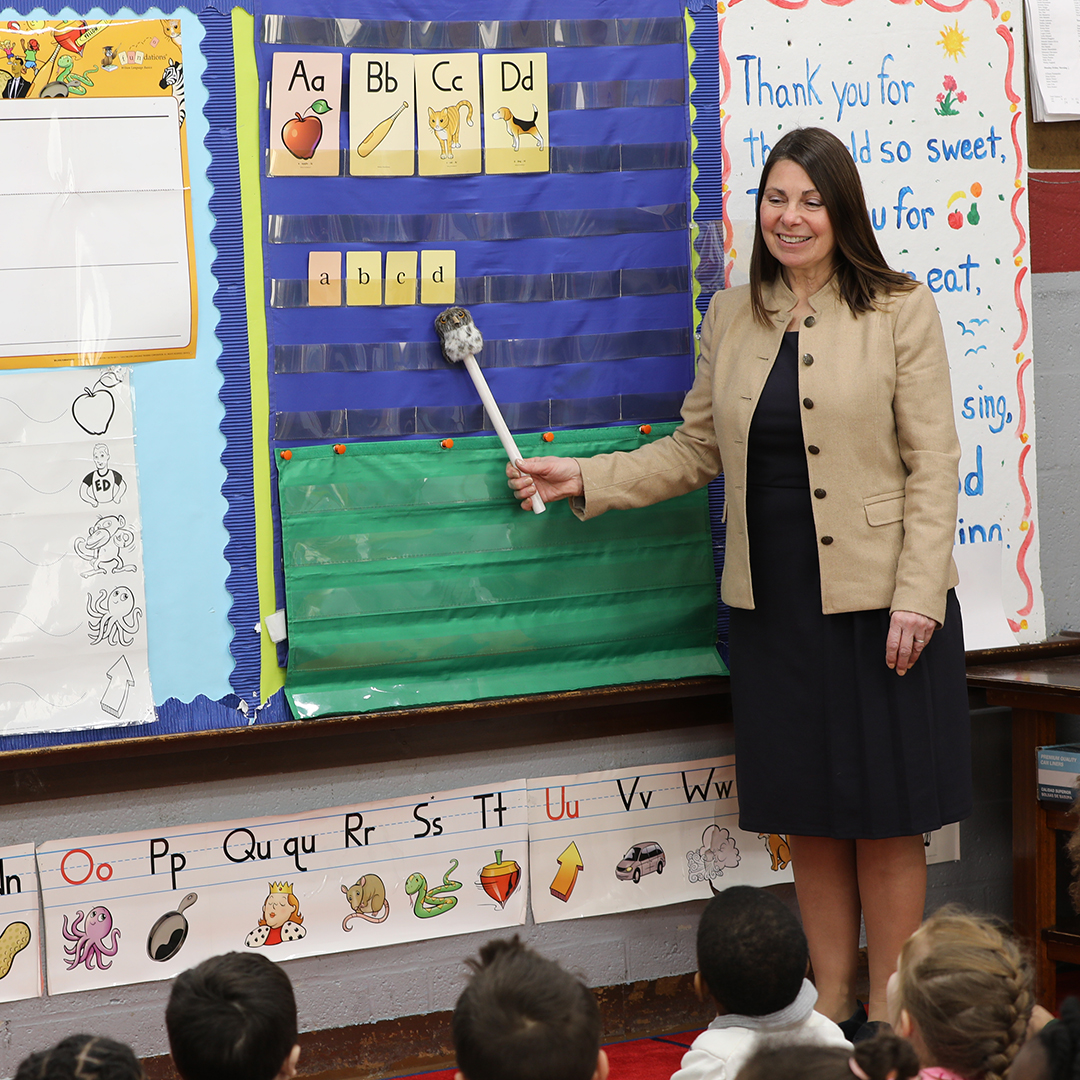
The NAEYC Early Learning Program Accreditation Standards and Assessment Items recognizes the development of the alphabetic principle as a goal for the preschool years. Standard 2.E—Early Literacy recommends “program plans and materials for supporting early literacy through reading, learning letters and sounds, writing, and immersion in a print-rich environment” (NAEYC, p.23). Fundations Pre-K Activity Set accomplishes these goals by:
- Directly teaching children that letters are associated with individual sounds within the spoken English language.
- Introducing students to the letter name and sound association with the help of a “keyword” picture.
- Explicitly and systematically teaching all 26 letters of the alphabet in the first 13 weeks of instruction and practiced daily throughout the year-long curriculum.
- Providing a daily letter-sound drill that helps students to gain automaticity with letter names to be able to name letters rapidly.
- Offering direct instruction in letter formation for both lowercase and uppercase letters.
Likewise, the Pre-K Activity Set strongly supports the following goals within the Preschooler Domain of Literacy in the Head Start Early Learning Outcomes Framework:
- Goal P-LIT 1: Child demonstrates awareness that spoken language is composed of smaller segments of sound.
- Phonemic awareness in the Fundations Pre-K Activity Set is fostered by directly teaching children that letters are associated with individual sounds within spoken English. By doing so, the program directly teaches children an important piece of metacognitive knowledge that specifically supports phonological awareness and phonemic awareness.
- Goal P-LIT 3: Child identifies letters of the alphabet and produces correct sounds associated with letters.
- In the Fundations Pre-K Activity Set, students are introduced to letter names and sound association with the help of a keyword picture. All 26 letters of the alphabet are explicitly and systematically taught in the first 13 weeks of instruction; they are then practiced daily throughout the year-long curriculum. The ability to name letters rapidly depends upon a student’s automaticity with letter names. A daily letter-sound drill helps students to gain that automaticity.
- In addition, the Fundations Pre-K Activity Set provides direct instruction in letter formation for both lower and uppercase letters. Letter formation is closely linked to sound-symbol recognition and is explicitly taught using gross motor sky writing activities, finger tracing, and copying and forming letters from memory.
The skills taught in the Fundations Pre-K Activity set align with those that the Report of the National Early Literacy Panel (2008) identified as strong and consistent predictors for the later development of literacy skills:
- Knowledge of the names and sounds associated with printed letters
- Ability to manipulate the sounds of spoken language
- Ability to rapidly name a sequence of letters, numbers, objects, or colors
- Ability to write isolated letters or one’s own name
- Ability to remember the content of spoken information for a short time
The focus during the first semester will be on teaching the alphabetic principle of letter-sound correspondence with the whole class. Students will practice:
- Recognition of the alphabetical order of letters a-z
- Letter name, keyword, and sound for the 26 letters of the alphabet (letter-sound correspondence)
- Visual connection between the letter name, its sound, and its grapheme (or written representation)
Further development of letter-sound correspondence (alphabetic principle) will continue with the whole class, and letter formation skills will be introduced in small groups. Students will practice:
- Letter formation for lowercase letters
- Letter formation for uppercase letters
- Association of a sound with a letter that is written